
Lower Makefield Previous Residents by Era
Past residents leave different kinds of evidence in different periods. A current address is only the opening point. First identify the parcel and owner-of-record reference. Then use the Recorder’s party index for the title sequence, the Township for defined building or planning files, and the archive or library shelf when the time period is older. The title trail can identify a sequence of recorded parties. It cannot establish every person who lived in the house, the day a household moved, or a full year-by-year list.
| Source | Years It Covers | Where Held | What It Shows |
|---|---|---|---|
| Bucks Recorder party indexes and instruments | 1684-present, in historic index groups | Recorder, paid LANDEX, and public research area | Recorded title parties and legal-description trail |
| Mercer deed books and grantor-grantee index | 1684-1919 | Mercer Museum/Bucks County Archives, on site | Earlier deed and index research when the modern path runs thin |
| Township building and property files | 1939-present record lead | Community Development staff or defined RTKL request | Plans, permits, surveys, inspections, and project history |
| Federal census | Publicly released through 1950 | National Archives and authorized genealogy access | Household and location on the enumeration date |
| Historical directories and telephone books | Discrete runs, not continuous | HathiTrust, library databases, and archives | Names, postal labels, and business or occupation clues when printed |
| Mercer obituary retrieval | Newspaper-dependent | Mercer Research Library | Death and family-history trail endpoint in indexed newspapers |
For a recent transfer, begin with the parcel, assessment or tax source, and Recorder reference. For an older house, the archive is often the next step rather than a promise that a web search will reach the first owner. For people who lived at an address, pair a dated directory or census entry with the title trail instead of treating a deed as a household record.
The Bucks County Property Records page describes the Recorder’s research routes and its historical party-index arrangement.
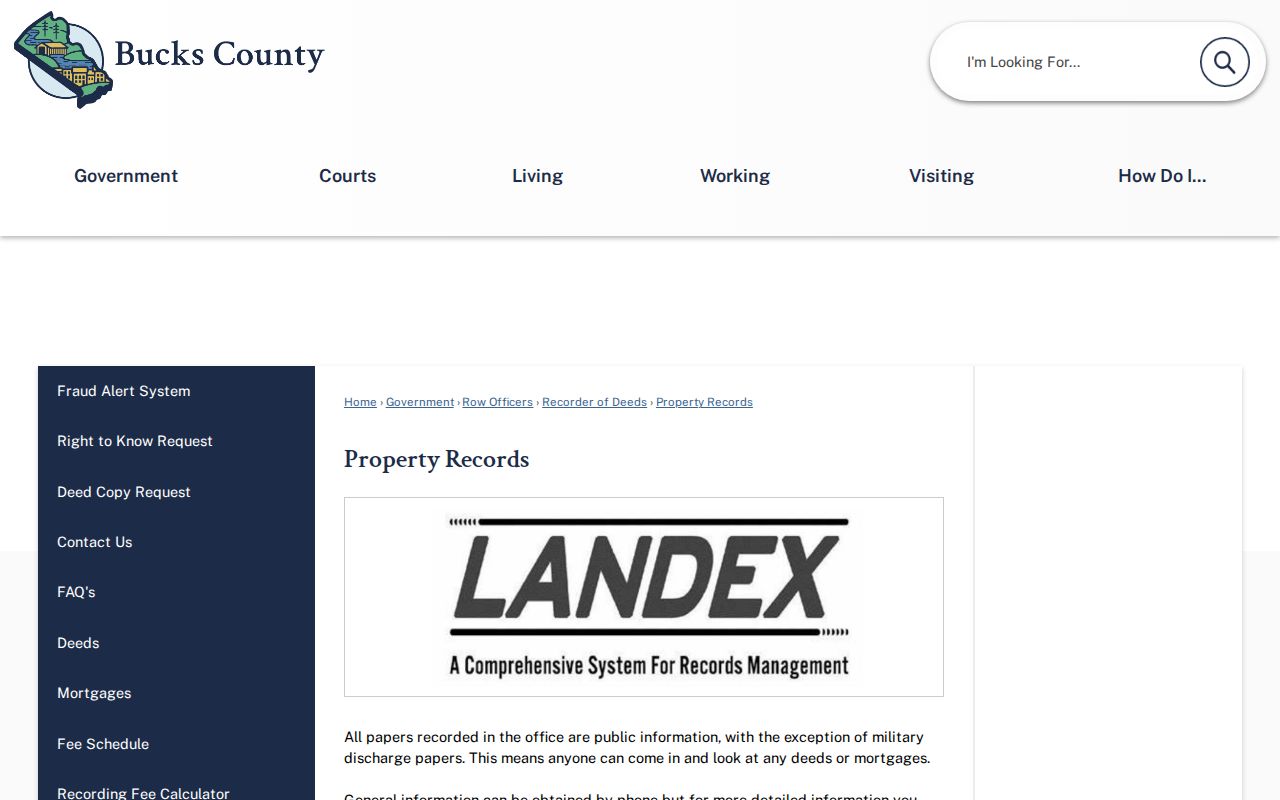
The Recorder is the title-record custodian, while the public research area, copy route, and paid LANDEX access serve different parts of the same recorded-document trail.
Start Lower Makefield Previous Residents at Parcel
Use the address to find the parcel before searching deed names. The Bucks Tax Claim inquiry accepts parcel number, location address, municipality, owner name, mailing address, city, and ZIP. It is a delinquent-tax and claim tool, not a universal current-owner roll, but it can provide the address and parcel lead. For a location address, enter the house number and street. Add Lower Makefield Twp to reduce countywide same-street confusion.
Next, confirm the parcel context through the Bucks Board of Assessment or County mapping. The County says public assessment data are uploaded weekly and that ownership changes may take longer to appear. A mailing address is not the same as the situs address, the physical parcel location. It may be where tax correspondence is sent. Neither field identifies every current or prior member of a household.
Where a building question remains, Lower Makefield Community Development is the local channel for permits, zoning, code, subdivision, and land-development material. Its building-property record lead reaches to 1939. No public historical permit-by-address browser was verified, so staff contact or a specific written request is the documented fallback.
Trace Lower Makefield Previous Residents Through Deeds
The Bucks deed chain runs backward through names and instruments, not directly through a street-address index. The Recorder calls a seller or borrower a Direct Party and a buyer or lender an Indirect Party. Carry the parcel number, deed book and page or document reference, approximate transfer date, and legal description from each step. Those facts keep a common surname from pulling the trail onto another Lower Makefield property.
- Obtain the current parcel, owner-of-record clue, and any book/page reference from assessment or tax-map sources.
- Find the current owner’s acquisition in the Recorder party index and obtain the instrument through LANDEX, the public research area, or the Recorder copy route.
- Record the grantor, grantee, recording date, parcel, legal description, and every prior reference cited in the instrument.
- Search the seller as an earlier Indirect Party near the preceding transfer year, then compare legal description and parcel details before accepting a match.
- Repeat the process backward. Move to Mercer’s on-site deed books and indexes when the earlier record is not resolved through the modern route.
- Grantor and grantee
- The grantor transfers an interest. The grantee receives it. In Bucks Recorder terms, seller or borrower activity is Direct Party material and buyer or lender activity is Indirect Party material.
- Chain of title
- A documented sequence of recorded transfers for one parcel. It is a legal-title sequence, not a list of all occupants.
- Legal description
- The lot, plan, metes-and-bounds, or other land description inside the instrument. It is more durable than a street string when a parcel changed in a subdivision.
- Book and page
- A reference to the recorded volume and page that helps bridge an assessment clue to the correct instrument.
Recorder records span 1684 to the present, but the historical books are grouped by era: 1684-1919, 1920-1941, 1942-1951, 1952-1963, 1964-1971, 1972-1979, 1980-1988, 1989-1993, 1994-1998, and 1999-present. Older names are not simply a phone-book-style alphabetical list. Arrive with an approximate year as well as a party name.
Note: The Recorder’s staff can provide tutorials and copies, but does not conduct title or historical research for a requester.
Bucks Index Eras for Lower Makefield Records
Several access channels support a past-residents search. LANDEX is the County-linked paid remote channel. The Recorder also maintains a public research area, and ordinary copies can be requested by phone or submission to the office. The published copy charge is $1 per page, with $1.50 added for certification. A property owner may request a complimentary email copy of that owner’s deed. Certified copies are not available through the Webstore.
Document timing matters when tracing a recent sale. Bucks says instruments ordinarily become available through LANDEX within 24 to 48 business hours and then move through a verification stage that ordinarily takes about three weeks. Treat that as operating guidance, not a guarantee. If a transfer seems absent, check the recording date, parcel, party spelling, and book/page before concluding the parcel did not change hands.
The County’s free Recorder Fraud Alert System monitors a registered name and County materials describe name and tax-parcel monitoring. It sends notice after a document is recorded. It does not establish ownership, prevent a filing, or replace reading the actual instrument.
Lower Makefield Previous Residents in Households
Recorded owners are only one layer of who lived here before. A directory or telephone book may give a spelling, business detail, postal label, or address when that edition includes it. A federal census puts a household at a location on its enumeration date, and public schedules now reach 1950. Neither source is continuous. A person who disappears from one edition may have moved, died, used a variant name, fallen outside the book’s stated coverage, or simply not appeared in that type of volume.
- Choose a directory or telephone-book edition nearest the transfer or household date being studied.
- Copy the name, locality label, and every printed address or occupation field without adding unprinted conventions.
- Compare that edition with the closest available census schedule, retaining each source’s own date.
- Test later changes with an obituary, estate file, deed, or another discrete directory edition.
The Bucks County Free Library family-history resource identifies HeritageQuest, FamilySearch, Power Library material, and NewsBank as local research paths. Library-card credentials may be required. Exact historic newspaper coverage was not stated, so verify access and dates before assuming a title will cover a particular year.
For the documented county and regional editions, the Lower Makefield city-directory collections record gives the source scope and entry cautions without treating a directory as a full resident list.
Mercer Archives and Lower Makefield Past Residents
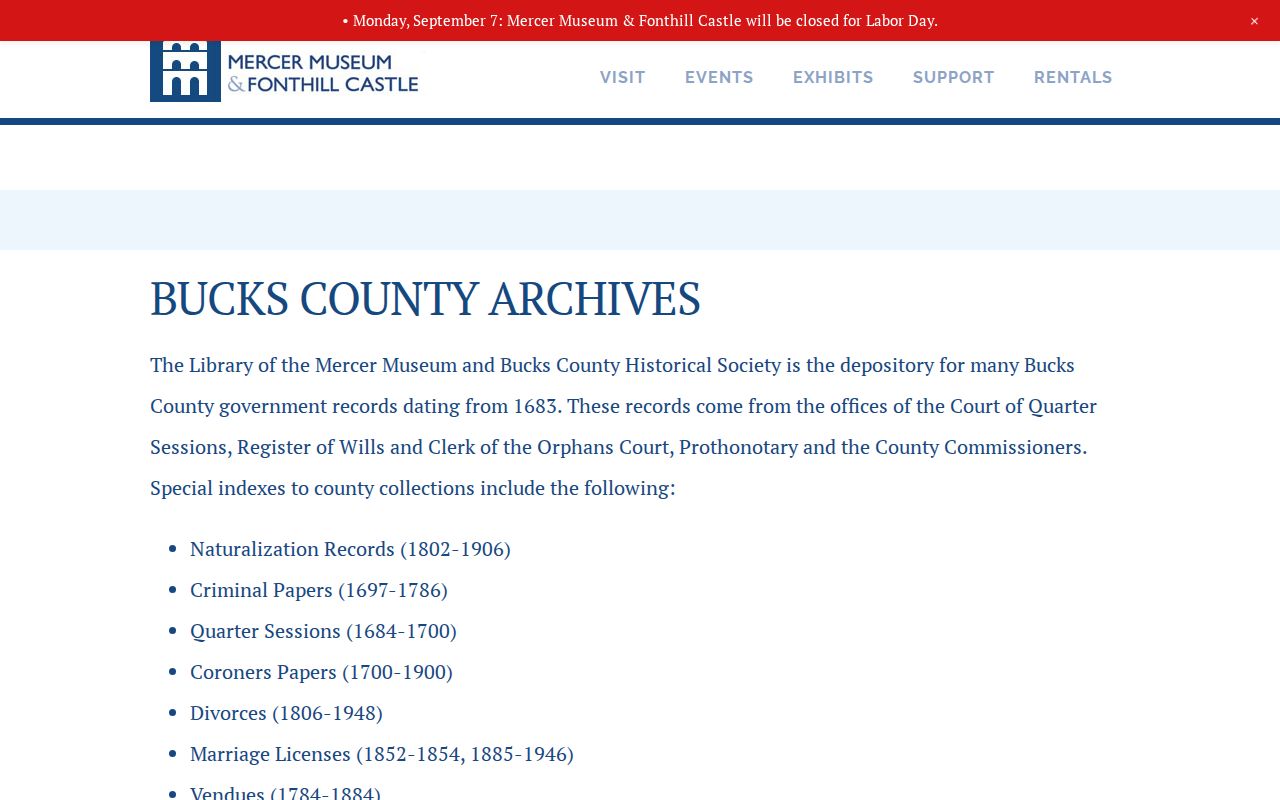
Mercer Museum’s Bucks County Archives is the essential offline step for early title and family material. It holds deed books and grantor-grantee indexes for 1684-1919, older wills and administrations, marriages, naturalizations, coroner material, and other county-government groups. The archive says the listed indexes are not online. An archive visit can therefore answer an early-title question that neither an address form nor a modern web result can resolve.
The Bucks County Archives collection description identifies the historical record groups and their date ranges.
Archive items are requested at the desk and consulted one at a time. Pencil or laptop notes are allowed. Camera licenses are $5 per day or $20 per year. Mercer’s $75 remote research service may help with a defined inquiry, but it does not do chain-of-title research by mail.
For a documented end-of-life clue, Mercer offers a $10 obituary retrieval service for indexed newspapers that include the Yardley News, Intelligencer, Courier Times, Bristol Pilot, and New Hope Gazette. Requests may be made by email or phone, using a decedent name and helpful date information. An obituary can add family context, not prove a person’s full residence history.
Lower Makefield Previous Residents in 2025 Survey
The Township’s September 2025 Historic Resource Survey is a major house-history context source. Its researchers evaluated 330 properties and documented 172. The method assembled tax, insurance, deed, atlas, map, aerial, newspaper, mechanics’ lien, photograph, and Recorder subdivision-plan evidence. Inventory fields can include parcel, address, owner type, construction details, historic and current use, build year or dating basis, and related resources. The report is valuable even when a property was not formally surveyed because it shows how local history was tested.
The Lower Makefield Historical Commission provides the Township’s local-history and historic-resource context.
Use the survey to add building context to a parcel file. It is not a current household roster and it does not replace a recorded instrument, a census schedule, or a library-held directory.
Edgewood Names for Past Resident Searches
A past-residents search can fail because the place name changed, not because the person is absent. The Historical Commission says the Edgewood community was called Stradlington, Biles Corner, Summerville, Edgewood, and Woodside at different times. Summerville appears in 1830 deeds and on the 1848 Kennedy Map. Woodside appears on 1905-11 USGS mapping, and Woodside and Edgewood coexisted into the 1970s.
Search those historical labels in deeds, maps, newspapers, and directory collections before tying a result to a modern address. The research did not locate an official townshipwide street-renumbering program. These names are historical vocabulary, not a confirmed conversion from one house number to another.
Note: Preserve the original place name beside the modern parcel reference so the reason for each search variant remains clear.
Limits on Lower Makefield Previous Residents
The evidence trail has clear edges. The Tax Claim form is a claims resource, not an occupancy list. Assessment and GIS sources can identify parcel and owner-of-record facts but not all occupants. A deed chain documents legal title, not every renter, family member, or move date. Township permit and planning files can explain a project, but they do not prove who lived in the building. Avoid treating a post-office label, a mailing address, or one historical entry as a complete answer.
If a Township-created file is needed and normal staff contact does not locate it, the Lower Makefield Right-to-Know route accepts an online, email, fax, mail, or written in-person request. Ask for an existing, defined record by address, date range, permit type, or file number. The Township says requests receive a response within five business days and notes that requests must seek records, not an explanation or a compiled answer.
Lawful personal use. Use past-resident research for house history, family history, estate work, or personal curiosity. Do not use a record trail to stalk, harass, or harm any living person.